
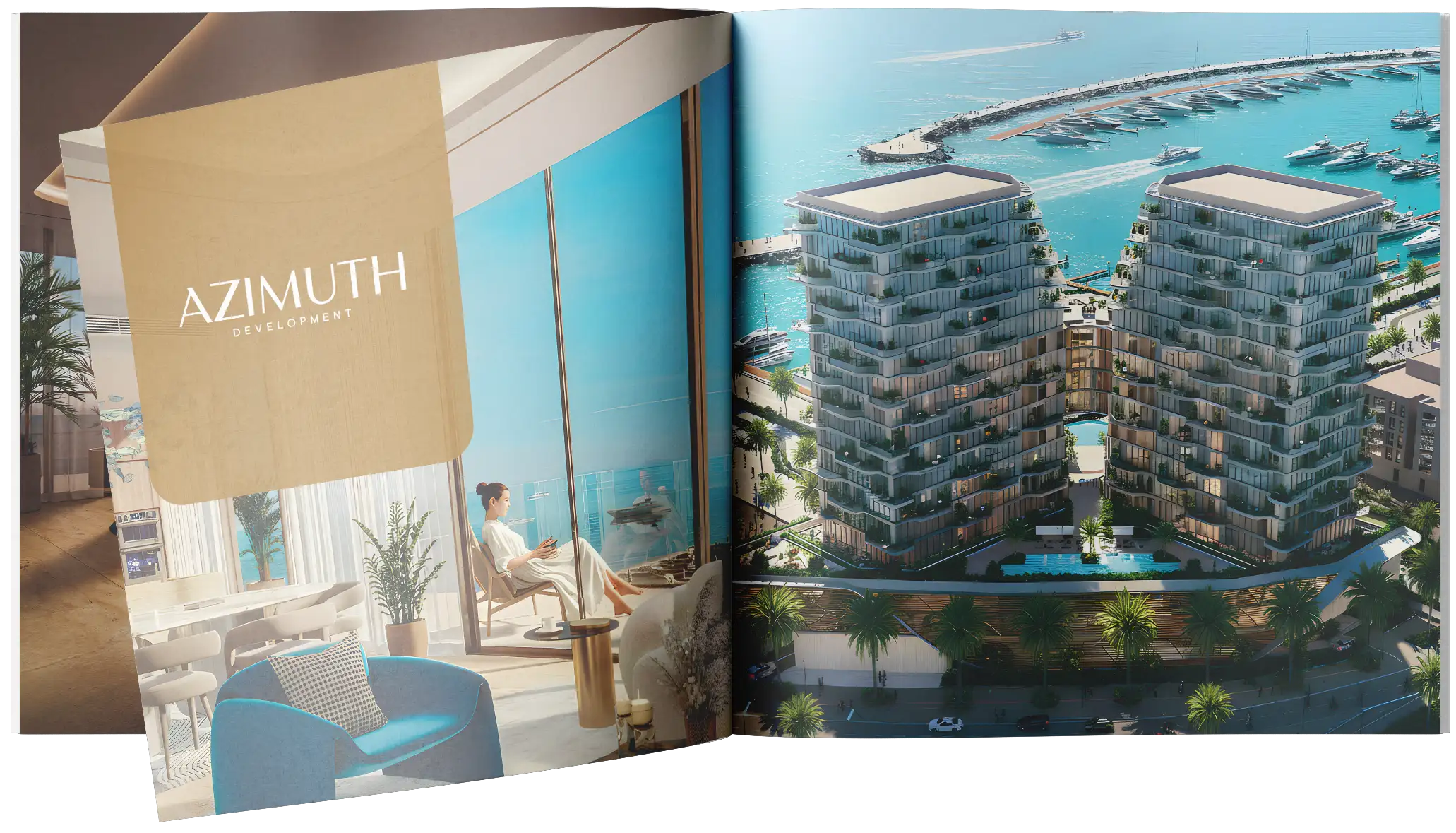
Royal Yacht Club Residence by Azimuth Development enters the Dubai Islands market with a clear proposition: it is not centered on tower density or a holiday-oriented concept, but on a residential scheme shaped by marina presence, practical unit layouts, and an island setting. This gives it a different tone from many apartment launches in Dubai, as its identity is defined more by living on the water than by skyline views.
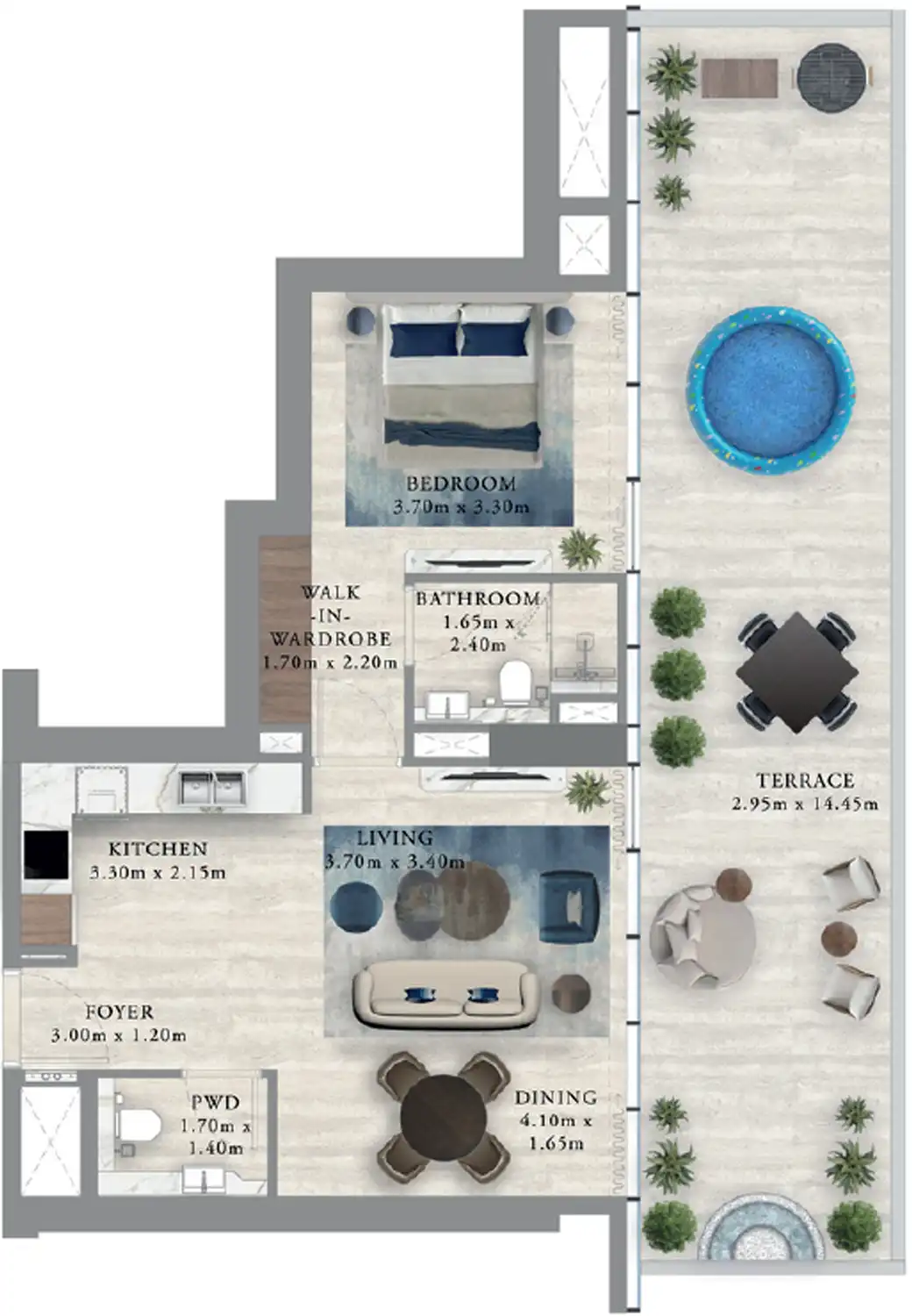
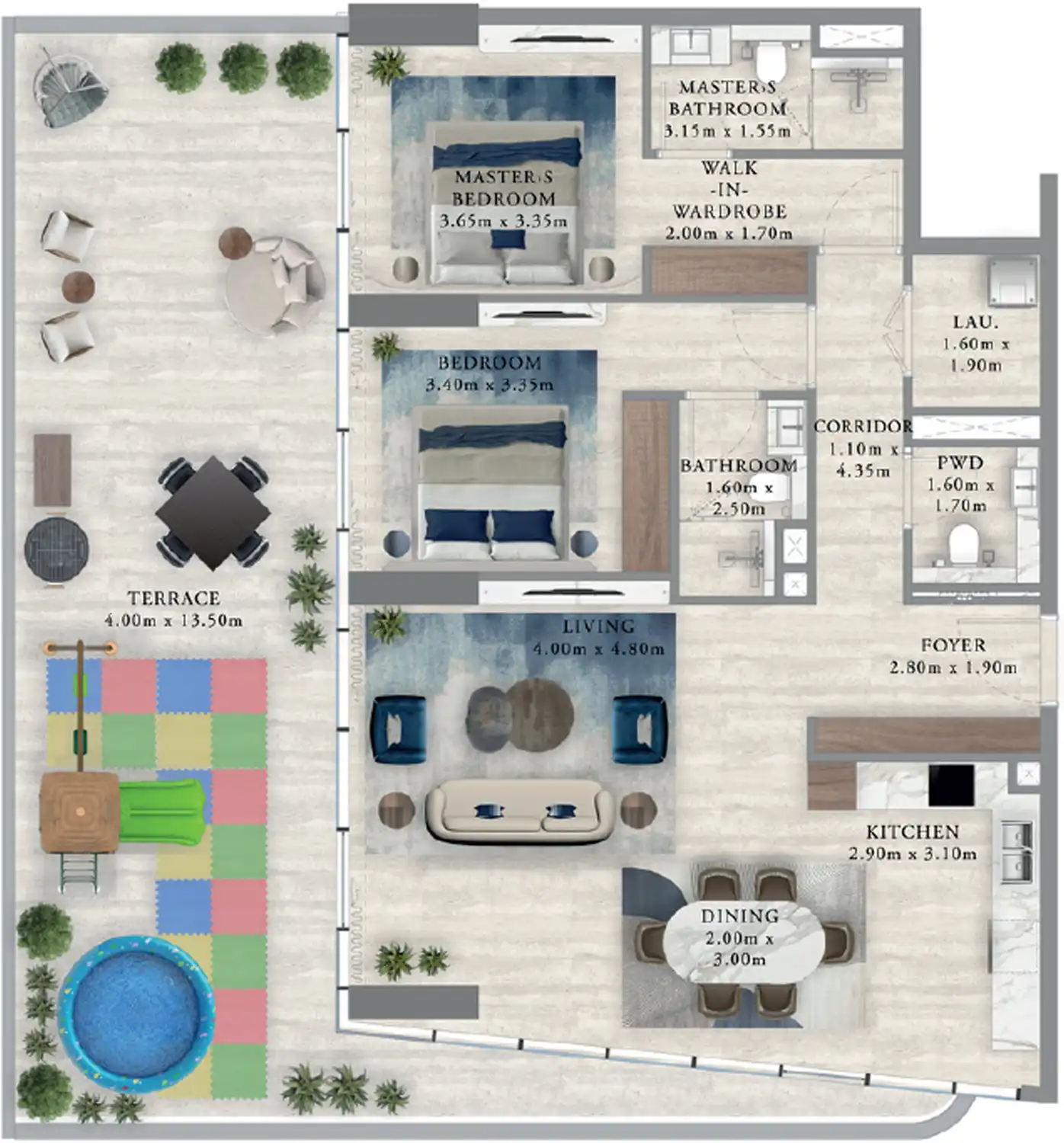
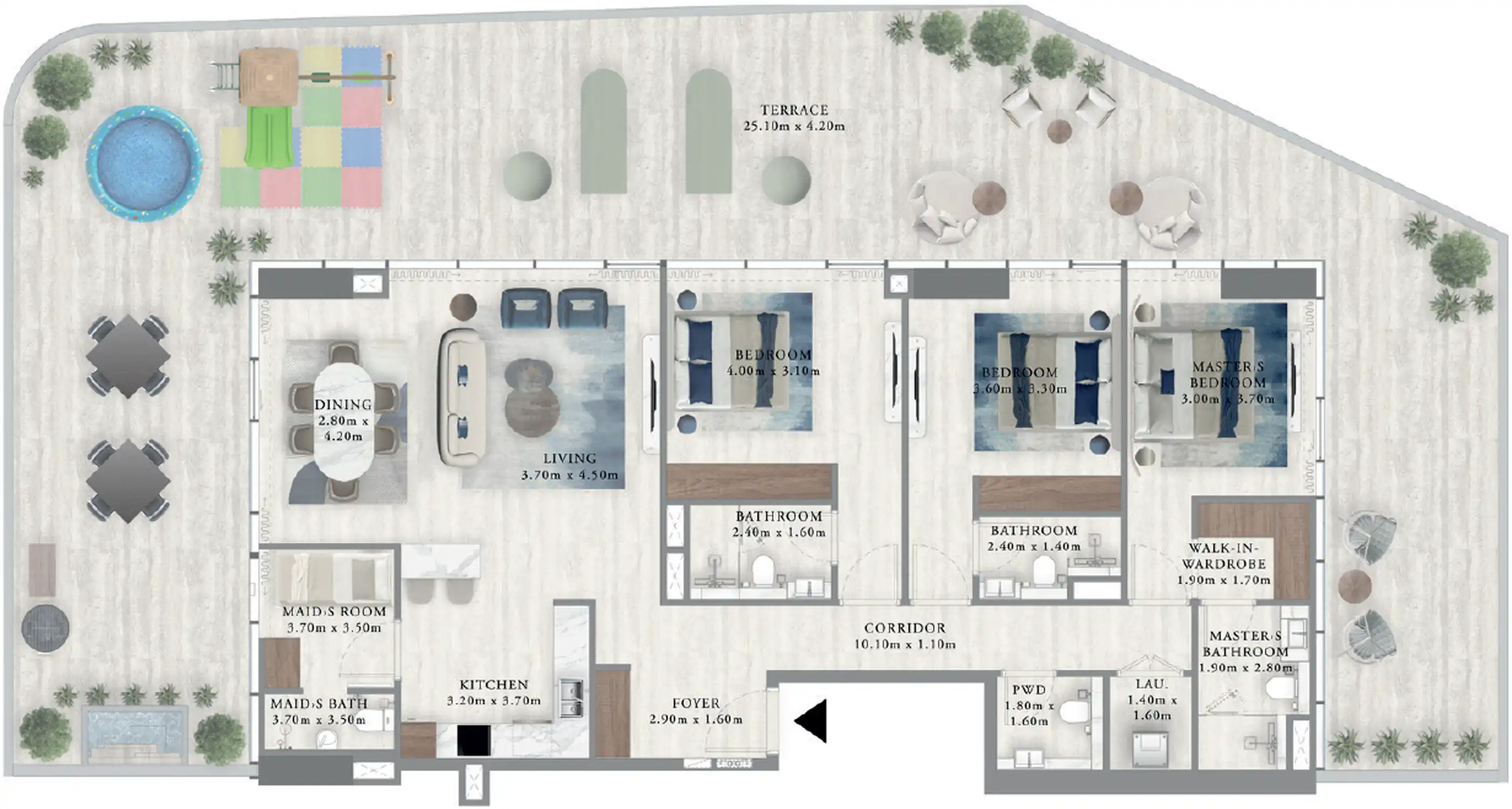
The available project data points to a premium entry price and a range that can accommodate family occupation rather than a volume-led small-unit strategy. The published unit matrix includes a 1-bedroom apartment from AED 2,300,000 (≈ $626,300) with 720 sqft / 66 m², and a 2-bedroom apartment from AED 3,200,000 (≈ $871,300) with 1,146 sqft / 106 m². It also includes a 3-bedroom apartment with 1,933 sqft / 179 m² and a 4-bedroom apartment with 2,304 sqft / 214 m², both available on request.
Within that context, the building design and planning logic contribute significantly to the project’s perceived value. Royal Yacht Club Residence is divided into Tower A and Tower B, and the plans show not only standard residential units but also duplexes and larger family layouts. As a result, the development is positioned to address different residential needs at once, from single occupants and couples to households requiring additional rooms, terraces, and more generous living space.
The interior character is also relevant to the way the project is positioned. Based on the plans and visuals, the design relies on curved forms, extensive glazing, and open internal space to draw the waterfront into the living environment and suggest that the water is not merely a backdrop but part of everyday residential use. In that sense, Royal Yacht Club Residence is presented first as a marina-facing residential product and second as an architectural statement.
The amenities are best understood through the daily routines they support. The social dimension of the building is anchored by the infinity pool, pool deck, family pool, lounge, and lobby space. This is consistent with the Dubai Islands setting, where the waterfront environment supports a more relaxed rhythm of daily life than the constant pace associated with central urban districts.
The fitness and wellness offering is relatively focused, consisting of a contemporary fitness center, indoor yoga space, and yoga terraces. Rather than attempting to compete with large resort clubs, the project concentrates on amenities that residents are likely to use regularly. This makes it read more credibly as a residential development than as a purely lifestyle-driven concept.
The family and comfort layer is comparatively straightforward, comprising children’s play areas, privacy-oriented shared spaces, and 24/7 security. While these features may appear standard on paper, they are important in a waterfront residential project because they make the development more suitable for long-term occupation rather than short-term use.



1-4 Bedroom Apartments
& Duplexes for Sale
at Dubai Islands
Royal Yacht Club Residence by Azimuth Development is a waterfront residential project in Dubai Islands with marina and promenade setting. The scheme offers 1- to 4-bedroom apartments and duplex layouts, supported by pools, fitness, yoga and family amenities.
50/50
Payment Plan
Q4 2027
Handover
AED 2,300,000
Starting Price
Royal Yacht Club Residence by Azimuth Development at Dubai Islands
Location in Dubai

Developer
Property Type
Available Units
Total Areas
Payment Plan
Completion
Photo Gallery
Renders may look slightly different than real life photos
Renders may look slightly different than real life photos
Floor Plans of Royal Yacht Club Residence at Dubai Islands
1-Bedroom
2-Bedroom
3-Bedroom
4-Bedroom
1-Bedroom Apartment
FROM AED 2,300,000 ($626,300)
Total Area: 720 sqft (66 m²)
2-Bedroom Apartment
FROM AED 3,200,000 ($871,300)
Total Area: 1146 sqft (106 m²)
3-Bedroom Apartment
Total Area: 1933 sqft (179 m²)
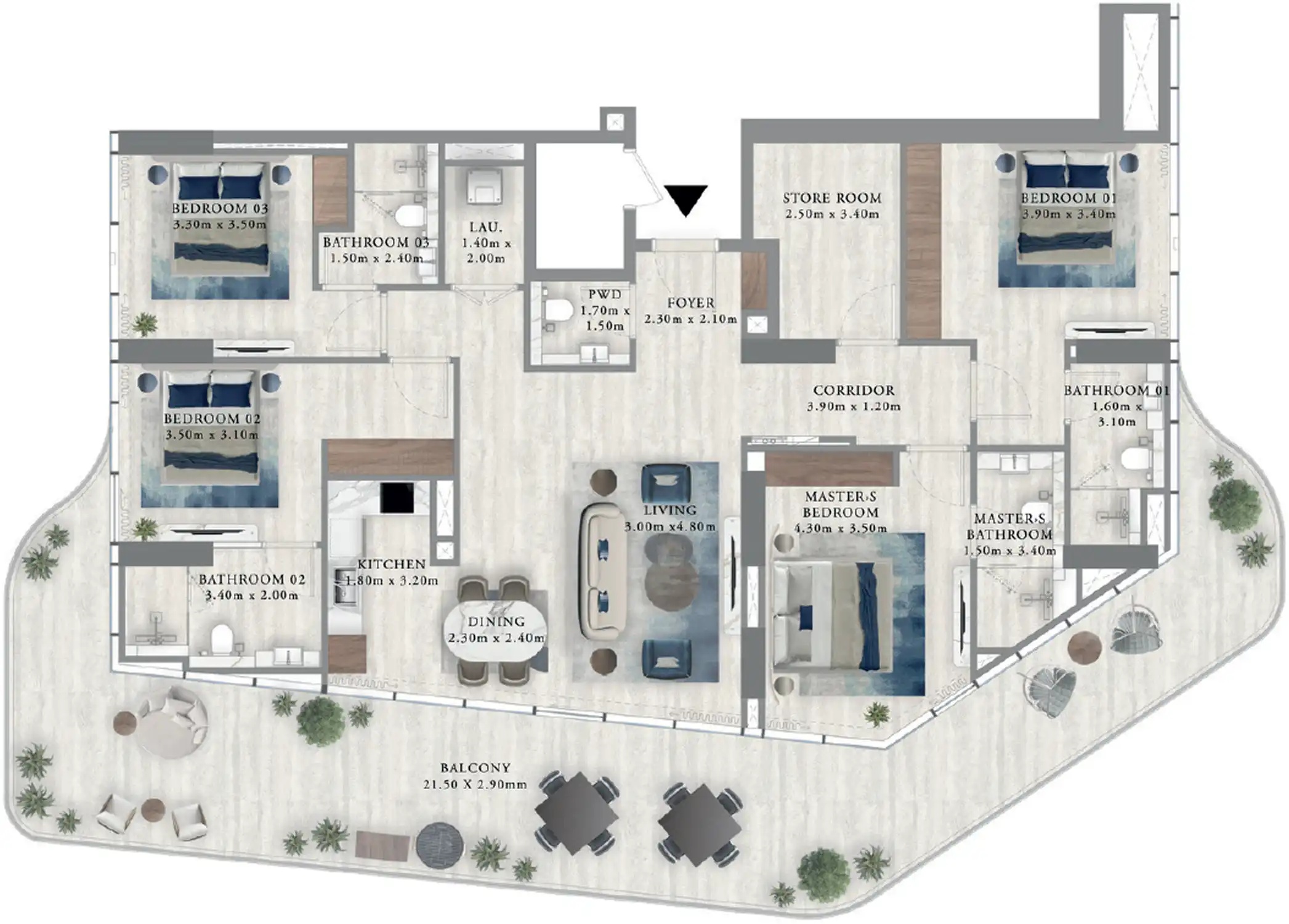
4-Bedroom Apartment
Total Area: 2304 sqft (214 m²)
Invest with Attractive
50/50 Payment Plan

Invest with Free-Interest
50/50 Payment Plan



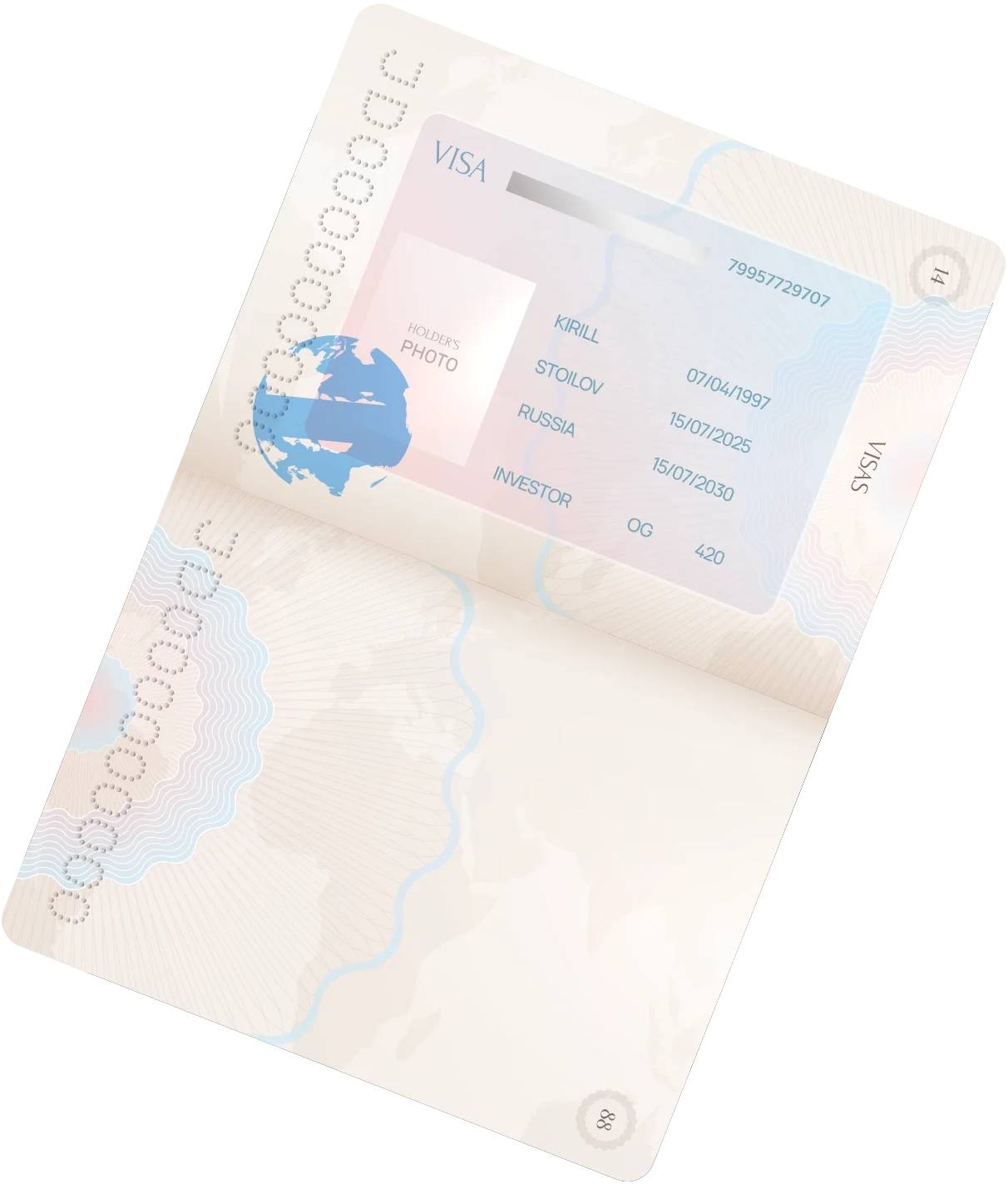



Become The UAE Visa Holder
for Property Investment
in Dubai
We can help you find flexible visa options
that encourage long-term investment

FIND OUT HOW TO GET THE UAE VISA


Property Location
is Dubai Islands
The district context is central to the strategic relevance of Royal Yacht Club Residence. Dubai Islands is a five-island waterfront district being developed by Nakheel, with plans for beaches, parks, golf courses, hospitality and retail offerings, and health and wellness facilities. This places the district in a distinctive position: it carries the visual language of a resort destination while remaining connected to the older commercial and cultural areas of Deira rather than being isolated on the city’s outer edge.
That combination makes the district practical as well as attractive. Dubai Islands Beach already provides a public beachfront component, while the nearby mainland offers destinations such as City Centre Deira, the Gold Souk, and Waterfront Market, which extend retail and everyday convenience beyond the islands themselves. For many buyers, this may be more meaningful than a long list of future promises, because it links new waterfront leisure with established urban infrastructure.
The transport profile follows the same logic. Royal Yacht Club Residence is located 10 minutes from Gold Souq Metro Station, 15 minutes from The Dubai Frame, 20 minutes from Dubai International Airport, 20 minutes from Downtown Dubai and Burj Khalifa, 21 minutes from Business Bay, 25 minutes from World Trade Center, 35 minutes from Burj Al Arab, 35 minutes from The Walk at JBR, and 35 minutes from Palm Jumeirah. Dubai Islands is accessible by road and sea and is connected to the mainland via the Infinity Bridge.
For families, the wider catchment is credible. Deira International School and Al Ittihad Private School Al Mamzar broaden the schooling options, while Dubai Hospital and Mediclinic Deira improve access to both major hospital care and outpatient services. This makes Dubai Islands more viable as a full-time residential location than waterfront districts that rely almost entirely on hospitality infrastructure.
Distance from Royal Yacht Club Residence at Dubai Islands to Key Locations in Dubai


40 MINUTES
20 MINUTES
20 MINUTES
25 MINUTES
35 MINUTES

Why Invest in Real Estate
at Dubai Islands?
From an economic perspective, the case is straightforward at a high level. Royal Yacht Club Residence benefits from its waterfront marina setting, a unit mix that extends beyond entry-level investor stock, and a location capable of attracting both lifestyle-led tenants and end-users seeking proximity to DXB, Deira, and central Dubai. On that basis, resale and rental prospects should logically benefit from the combination of setting and connectivity, particularly for buyers seeking waterfront living without losing access to established city infrastructure.
Viewed as a whole, Royal Yacht Club Residence by Azimuth Development appears to be a credible residential opportunity within Dubai Islands because it brings together three elements with reasonable clarity: a marina-front product profile, an amenity package that is restrained but functional, and a lifestyle proposition that combines resort-style waterfront living with practical access to Deira. That creates a more durable basis for interest than marketing hype and helps explain the project’s relevance within the current Dubai Islands development pipeline.


Get The Brochure on WhatsApp 
Get The Brochure
on WhatsApp





Frequently Asked Questions About
Royal Yacht Club Residence at Dubai Islands
Frequently Asked Questions About Royal Yacht Club Residence at Dubai Islands
Where is Royal Yacht Club Residence located?
Royal Yacht Club Residence by Azimuth Development is located in Dubai Islands, Dubai, UAE.
What property types are available at Royal Yacht Club Residence?
Royal Yacht Club Residence includes 1- to 4-bedroom apartments, and duplex layouts are also part of the project.
What are the prices at Royal Yacht Club Residence?
Prices start from AED 2,300,000 ($626,300) for a 1-bedroom and AED 3,200,000 ($871,300) for a 2-bedroom. Prices for 3-bedroom and 4-bedroom residences are available on request.
What is the payment plan for Royal Yacht Club Residence?
The payment plan for Royal Yacht Club Residence is 20% on booking, 30% during construction and 50% upon handover.
When is handover for Royal Yacht Club Residence?
The handover date for Royal Yacht Club Residence is Q4 2027.
What amenities are available at Royal Yacht Club Residence?
Amenities at Royal Yacht Club Residence include an infinity pool and pool deck, a family pool, a modern fitness center, indoor yoga, a yoga garden and terraces, children’s play areas, a multi-purpose community lounge, a lobby and 24/7 security.


Hi, I'm Victoria 
Hi, I'm Victoria
Property Investment Expert at in.ae
Your Property Investment Expert at in.ae
If You Have Any Questions About Real Estate in The UAE, I'd Be Happy to Answer 


FROM AED 888,000 ($241,800)



FROM AED 4,500,000 ($1,225,300)
 UAE GOLDEN VISA

FROM AED 2,850,000 ($776,000)
UAE GOLDEN VISA


FROM AED 3,100,000 ($844,100)
UAE GOLDEN VISA


FROM AED 3,990,000 ($1,086,500)
UAE GOLDEN VISA

FROM AED 1,100,000 ($299,500)

FROM AED 1,460,000 ($397,500)


FROM AED 1,500,000 ($408,500)

FROM AED 700,000 ($190,600)

FROM AED 666,000 ($181,300)

FROM AED 666,000 ($181,400)









 23/11/2025









1
Be The First to Know
About New UAE Properties
1
Let's subscribe to the in.ae digest to get access to property pre-launches in Dubai, Abu Dhabi, Ras Al Khaimah, Sharjah, Ajman and Umm Al Quwain. Zero spam.

UAE, Dubai, Palm Jumeirah,
Golden Mile Eight, Office 12

UAE, Dubai, Palm Jumeirah, Golden Mile Eight, Office 12
The Special Project of