
In Dubai, waterfront areas often fall into two distinct categories: destinations with strong visual appeal but limited connectivity, and well-connected locations that offer less residential atmosphere. Lumea Residence appears to occupy a middle ground between these two models. Although it is located in Dubai Islands and benefits from a clear waterfront identity, its key reference points are not remote leisure destinations. Instead, they include Deira, DXB, major road links, and other established urban locations. This changes how the project should be interpreted. Rather than reading it primarily as a lifestyle-led proposition, it is more accurate to view Lumea Residence as a residential opportunity for buyers seeking a waterfront address without losing access to the city. That distinction is important because it helps define the likely target market and the project’s potential performance as either a home or an investment.
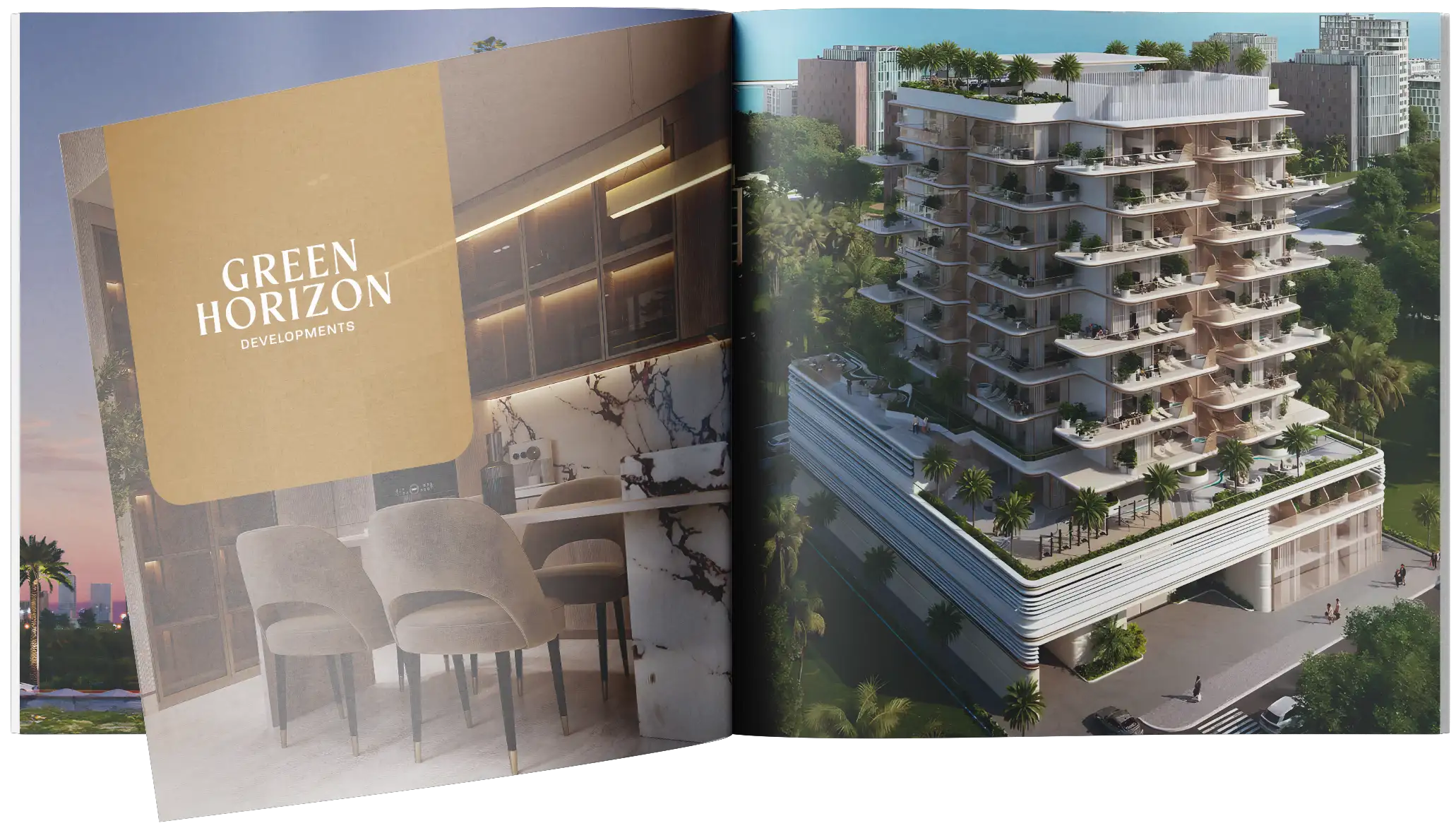
Developed by Green Horizon Development, the project takes the form of a G + 2P + 8 + R building, with residential levels from Level 1 to Level 8. It presents a clear and consistent model of a freehold, mid-rise residential development in Dubai Islands, offering 1-bedroom, 2-bedroom, and 3-bedroom apartments. Current pricing places the 1-bedroom units at AED 1,589,000, or $432,700, for 774 sqft or 71.9 m². The 2-bedroom apartments are priced at AED 2,264,000, or $616,500, for 1,201 sqft or 111.6 m², while the 3-bedroom units are offered at AED 3,500,000, or $953,000, for 1,849 sqft or 171.8 m². Overall, unit sizes across the project range from 774 sqft, or 71.9 m², to 2,501 sqft, or 232.4 m². Handover is scheduled for Q1 2028, and the payment plan is structured as 10% on booking, 25% during construction, and 65% on handover.
The project’s positioning is strengthened by the fact that it remains clearly legible as a residential building first. It is not overburdened with destination-scale claims. Instead, the more relevant details lie in the nature of the asset itself: manageable building massing, a standard apartment format, and a finish specification intended to place the development in a more refined category. Italian porcelain tiles, Italian quartz kitchen surfaces, built-in wardrobes, curtains, joinery works, and Miele or Bosch appliances, or equivalent, suggest an end product designed to present well to both owner-occupiers and future tenants.
The amenity offering is more convincing when viewed through the lens of everyday residential use. The wellness component is the most straightforward. An indoor swimming pool and gymnasium provide the core daily facilities residents are most likely to use. In this context, a more inflated amenity narrative would arguably be less relevant. For many buyers, consistency and practicality matter more than variety for its own sake.
A second layer relates to family use and open-air space. The landscaped garden and children’s play area do not function merely as decorative additions; they help define how the development may operate for households that need space beyond the private apartment. The landscaped garden softens the transition between apartment living and the wider district, while also contributing a sense of residential calm that is valuable in this type of mid-rise residential development. A third layer concerns social and convenience functions, where rooftop facilities, podium-level shared spaces, and restaurants support informal downtime rather than entertainment-heavy use. CCTV security completes the project’s operational framework.



Waterfront 1-3 Bedroom
Apartments for Sale
at Dubai Islands
Lumea Residence by Green Horizon Development is an apartment project in Dubai Islands. It includes 1 to 3-bedroom residences and a practical amenity offering with rooftop and podium areas, an indoor pool, a gym, landscaped gardens, and restaurants for residents.
35/65
Payment Plan
Q1 2028
Handover
AED 1,589,000
Starting Price
Lumea Residences at Dubai Islands
Location in Dubai

Developer
Property Type
Available Units
Total Areas
Payment Plan
Completion
Photo Gallery
Renders may look slightly different than real life photos
Renders may look slightly different than real life photos
Floor Plans of Lumea Residences at Dubai Islands
1-Bedroom
2-Bedroom
3-Bedroom
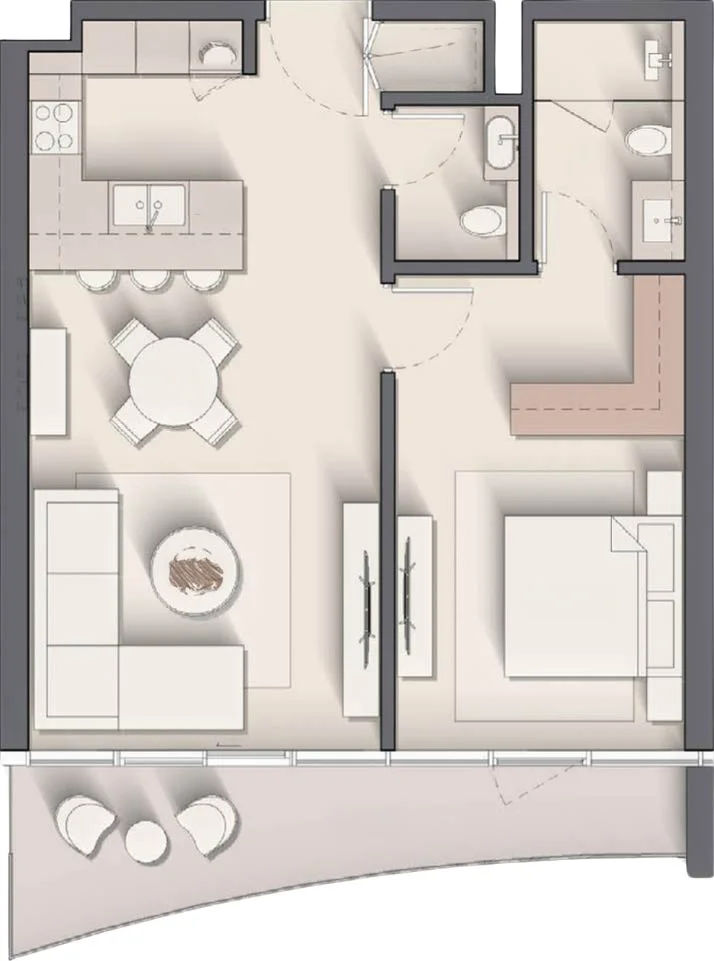
1-Bedroom Apartment
FROM AED 1,589,000 ($432,700)
Total Area: 774 sqft (72 m²)
2-Bedroom Apartment
FROM AED 2,264,000 ($616,500)
Total Area: 1201 sqft (112 m²)
3-Bedroom Apartment
FROM AED 3,500,000 ($953,000)
Total Area: 1849 sqft (172 m²)

Invest with Attractive
35/65 Payment Plan

Invest with Free-Interest
35/65 Payment Plan






Become The UAE Visa Holder
for Property Investment
in Dubai
We can help you find flexible visa options
that encourage long-term investment

FIND OUT HOW TO GET THE UAE VISA


Property Location
is Dubai Islands
The wider district plays a significant role in supporting the project’s overall value proposition. Dubai Islands may be framed as a waterfront district in promotional terms, but in practical terms its importance lies in its adjacency to established parts of the city. It has a marine and leisure identity, yet it also connects to an older part of Dubai with a long-established pattern of retail, services, and transportation. For buyers focused on livability, this is often more important than broader language about the area’s long-term vision.
The surrounding infrastructure is well developed and easily recognisable. Gold Souk, Al Ghurair Centre, Deira City Centre, Waterfront Market, and Dubai Mall create a retail network that ranges from daily convenience to major shopping destinations. Leisure access is reinforced by Al Mamzar Beach, Al Mamzar Beach Park, La Mer Beach, and Jumeirah Public Beach, extending the lifestyle dimension beyond the immediate project. For families, the surrounding catchment includes The Elite English School, Pristine Private School Main Campus, The Apple International School Primary Campus, Safa British School, and Collegiate International School. Healthcare provision is supported by Dubai Hospital, Canadian Specialist Hospital, and Clemenceau Medical Center Hospital. This is significant because it shows that the project does not rely on waterfront scenery alone; it is also supported by established urban infrastructure.
Connectivity appears to be one of the development’s strongest practical advantages. According to the stated drive times, Infinity Bridge and Hyatt Regency are 5 minutes away. The nearest metro station, Gold Souk, Dubai Hospital, Al Mamzar Beach, and Deira City Centre are each 5 minutes away. Canadian Specialist Hospital is 10 minutes away, while Dubai International Airport is 10 minutes away. Cruise Terminal and La Mer Beach are 15 minutes away, and Jumeirah Mosque, Jumeirah Public Beach, and Dubai Frame are 20 minutes away. Downtown Dubai and Dubai Mall are both 20 minutes away. The road network further links the project to Al Khaleej Street, Sheikh Zayed Road, Al Khail Road, Sheikh Mohammed Bin Zayed Road, and Al Ain-Dubai Road. Together, these connections make the development easier to justify for residents whose routines extend beyond the coastal zone and into multiple parts of the city.
In terms of audience, Dubai Islands supports more than one use case. End users may value the balance between waterfront living in Dubai and access to the city, particularly if they do not want a resort-style location. Investors may view that same balance as beneficial from a rental perspective, since it broadens the likely tenant base. Professionals, couples, and small families all have credible reasons to consider a location that combines access to the waterfront with proximity to schools, healthcare, and the airport.
Distance from Lumea Residences at Dubai Islands to Key Locations in Dubai


50 MINUTES
10 MINUTES
25 MINUTES
5 MINUTES
20 MINUTES

Why Invest in Real Estate
at Dubai Islands?
The financial appeal of Lumea Residence is therefore based on breadth of demand rather than speculation. The project benefits from a waterfront location, established surroundings, freehold ownership, and a unit mix that does not narrow the target audience too sharply. The payment structure is also relatively favourable, with the majority of the capital deferred to handover. The finishing standard should support solid day-one presentation.
Overall, Lumea Residence reads as a disciplined residential proposition in Dubai Islands rather than an oversized statement asset. Green Horizon Development is delivering a mid-rise, freehold apartment building with clear pricing, defined unit sizes, and a straightforward construction-linked payment structure. The project’s strongest quality is that its waterfront setting is supported by genuine access to the city, giving it a more durable and practical profile than many Dubai waterfront developments that rely too heavily on image.


Get The Brochure on WhatsApp 
Get The Brochure
on WhatsApp





Frequently Asked Questions About
Lumea Residences at Dubai Islands
Frequently Asked Questions About Lumea Residences at Dubai Islands
Where is Lumea Residence by Green Horizon Development located?
Lumea Residence is located at Island A, Dubai Islands, Dubai, UAE.
What property types are available at Lumea Residence?
Lumea Residence offers freehold apartments in 1-bedroom, 2-bedroom, and 3-bedroom layouts.
What are the current prices at Lumea Residence?
Current prices start from AED 1,589,000 ($432,700) for a 1-bedroom, AED 2,264,000 ($616,500) for a 2-bedroom, and AED 3,500,000 ($953,000) for a 3-bedroom.
What is the payment plan for Lumea Residence?
The payment plan is 10% on booking, 25% during construction, and 65% upon handover.
When is handover expected for Lumea Residence?
Handover for Lumea Residence is expected in Q1 2028.
What amenities are available at Lumea Residence?
Amenities at Lumea Residence include rooftop amenities, Podium 1 and Level 1 amenities, an indoor swimming pool, landscaped gardens, a gymnasium, a children’s play area, restaurants, and CCTV security.


Hi, I'm Victoria 
Hi, I'm Victoria
Property Investment Expert at in.ae
Your Property Investment Expert at in.ae
If You Have Any Questions About Real Estate in The UAE, I'd Be Happy to Answer 


FROM AED 5,094,000 ($1,387,100)
 UAE GOLDEN VISA




FROM AED 888,000 ($241,800)

FROM AED 4,500,000 ($1,225,300)
UAE GOLDEN VISA

FROM AED 2,850,000 ($776,000)
UAE GOLDEN VISA


FROM AED 3,100,000 ($844,100)
UAE GOLDEN VISA


FROM AED 3,990,000 ($1,086,500)
UAE GOLDEN VISA

FROM AED 1,100,000 ($299,500)

FROM AED 1,460,000 ($397,500)


FROM AED 1,500,000 ($408,500)









 23/11/2025









1
Be The First to Know
About New UAE Properties
1
Let's subscribe to the in.ae digest to get access to property pre-launches in Dubai, Abu Dhabi, Ras Al Khaimah, Sharjah, Ajman and Umm Al Quwain. Zero spam.

UAE, Dubai, Palm Jumeirah,
Golden Mile Eight, Office 12

UAE, Dubai, Palm Jumeirah, Golden Mile Eight, Office 12
The Special Project of